
India’s government is demanding answers from Meta, Wall Street is questioning the enormous cost of the AI race, and a newly revealed cloud vulnerability has once again put cybersecurity in the spotlight. Here’s what happened and why it matters.
The technology world is having one of those weeks where politics, artificial intelligence, financial markets and cybersecurity collide.
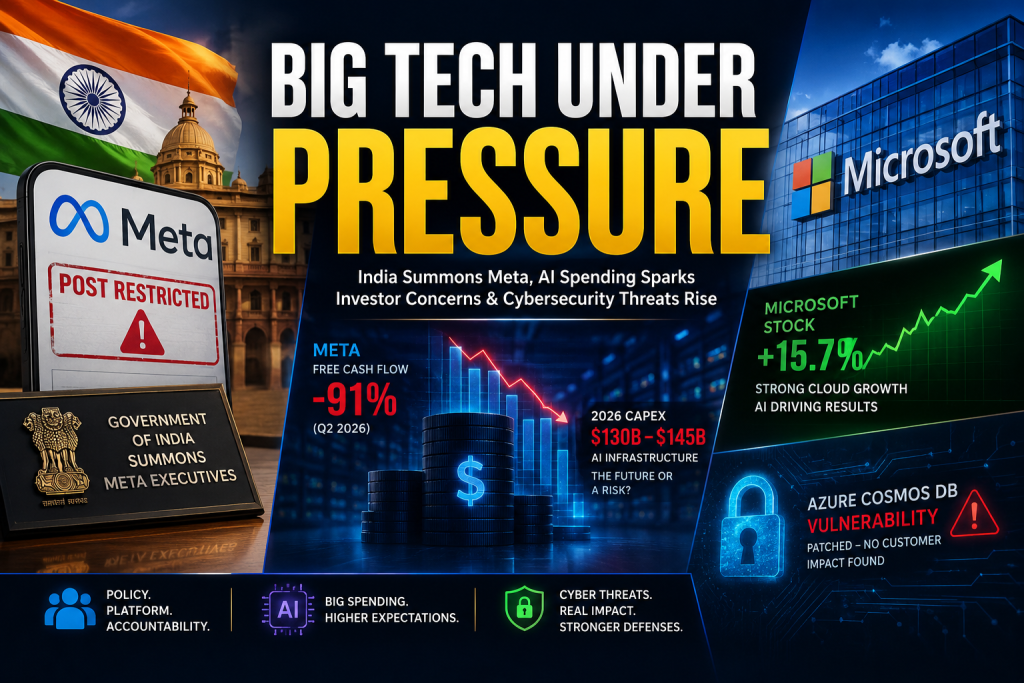
In India, the government has summoned senior Meta executives after a Facebook post from Prime Minister Narendra Modi was temporarily restricted. At the same time, Meta’s enormous artificial-intelligence spending is putting pressure on investor confidence, while Microsoft is showing that the AI spending story can look very different when cloud revenue starts delivering strong returns.
And just when the industry thought it had enough to worry about, cybersecurity researchers disclosed a serious vulnerability in Microsoft Azure’s Cosmos DB service that could potentially have exposed a large number of cloud customers.
Here’s the bigger picture.
In India Summons Meta Executives Over Restricted Modi Post
India has summoned executives from Meta after Facebook temporarily restricted a video post from Prime Minister Narendra Modi.
The video was initially uploaded to Instagram and was later shared on Facebook, where it was briefly unavailable. Meta said the restriction happened inadvertently and was the result of an error. However, Indian authorities have sought a clearer explanation and assurances that similar incidents will not happen again.
The issue is bigger than one social-media post.
For governments around the world, platforms such as Facebook, Instagram and YouTube have become critical channels for political communication. When content from a major political leader is restricted—even temporarily—questions immediately emerge over whether the action was caused by automated moderation, a technical failure or the platform’s enforcement policies.
According to reporting from India, the government has indicated that Meta’s explanation of the incident requires deeper discussion.
Why this matters for social media
Meta operates some of the world’s largest communication platforms, and its automated moderation systems handle enormous volumes of content every second.
That creates a difficult balancing act.
Platforms must remove harmful or policy-violating material while avoiding accidental restrictions on legitimate political speech. A single moderation mistake can quickly turn into a regulatory or diplomatic problem—especially in a country as large as India.
For Meta, the latest incident is another reminder that content moderation is no longer just a technical issue. It has become a major governance and political challenge.
🤖 Meta’s Massive AI Spending Is Making Investors Nervous
While Meta is dealing with regulatory pressure in India, the company is facing another battle on Wall Street: convincing investors that its huge AI investments will eventually generate enough money to justify the cost.
Meta reported that its free cash flow plunged 91% in the second quarter of 2026 to about $784 million, compared with $8.55 billion a year earlier.
The company has also raised its 2026 capital-spending forecast to between $130 billion and $145 billion, with AI infrastructure—including data centers, servers, chips and energy capacity—driving much of the investment.
That is an extraordinary amount of money.
Meta CEO Mark Zuckerberg is betting that massive computing capacity will become a strategic advantage as the company develops AI assistants, personal AI agents and other next-generation products.
But investors are asking a straightforward question:
When does the spending start paying back?
That uncertainty pushed Meta shares down by more than 9% after its latest results.
The AI boom is becoming an investment test
For years, investors rewarded Big Tech companies for aggressively spending on artificial intelligence.
Now the mood is becoming more selective.
It is no longer enough to announce a giant data center, buy more AI chips or promise a powerful next-generation model. Investors increasingly want evidence that these investments can generate revenue, improve margins or strengthen an existing business.
Meta’s advertising business remains powerful, but the scale of its AI infrastructure spending has raised concerns about cash flow and the timeline for returns.
That could become one of the biggest financial stories of the AI era.
📈 Microsoft Shows the Other Side of the AI Story
Microsoft’s latest results offered a much more optimistic picture.
While Meta faced a sharp market reaction, Microsoft shares surged as investors responded positively to strong quarterly results and continued growth in Azure and AI-related services.
The Associated Press reported that Microsoft stock jumped 15.7%, helping the broader technology market recover. The Nasdaq gained about 2.5%, while the S&P 500 rose around 1.2%.
So why are investors treating Microsoft differently?
The answer is relatively simple: AI is producing visible business results.
Microsoft can monetize AI through Azure cloud infrastructure, Microsoft 365, Copilot and enterprise services. That creates a more direct connection between AI investment and revenue.
Meta, by comparison, is investing heavily in computing infrastructure for its own AI ambitions, but much of the long-term monetization story remains to be proven. Reuters noted that Meta lacks the same immediate cloud-business pathway that companies such as Microsoft, Amazon and Google have.
This is an important shift.
The market may no longer reward AI spending equally. Instead, investors appear increasingly interested in AI economics—how much companies spend, what they get in return and how quickly those investments translate into sustainable profits.
🔥 The Bigger Tech Market Is Sending a Warning
The latest market moves suggest that the AI boom has entered a more mature phase.
Investors are still excited about artificial intelligence, but excitement alone is no longer enough.
Microsoft’s strong reaction shows what happens when investors see accelerating cloud demand and evidence that AI can generate revenue. Meta’s decline illustrates the opposite problem: huge spending combined with uncertainty over when the investment will translate into meaningful financial returns.
That creates an increasingly important divide inside Big Tech:
Build aggressively now—or prove the business case first?
Companies that find the right balance could emerge as the biggest winners of the AI race.
🔐 Major Cybersecurity Warning: Azure Cosmos DB Flaw Discovered
The financial story is only half of this week’s tech drama.
Cybersecurity researchers at Wiz disclosed a serious vulnerability affecting Microsoft Azure Cosmos DB, a cloud database service used by organizations around the world.
According to Reuters, the flaw could potentially have allowed remote attackers to compromise Cosmos DB customers. Microsoft has since addressed the issue and said it found no evidence of customer impact.
The incident is significant because Cosmos DB sits underneath a wide range of cloud-powered applications, including web services, recommendation systems, chatbots and Microsoft’s own services.
A vulnerability in a widely used cloud platform can create a much larger blast radius than an attack targeting a single company.
Cloud infrastructure is becoming a high-value target
The latest discovery highlights a major cybersecurity reality: as businesses move more operations into cloud platforms, cloud infrastructure itself becomes an increasingly attractive target for attackers.
The problem isn’t limited to stealing passwords anymore.
Attackers are looking for vulnerabilities in APIs, identity systems, cloud databases, software dependencies and infrastructure management tools.
That means cloud security is becoming just as important as traditional endpoint protection.
🛡️ Microsoft’s July Security Update Was Massive
The latest Azure issue arrives alongside Microsoft’s large July security update.
Microsoft addressed 622 vulnerabilities in its July 2026 Patch Tuesday release, according to CrowdStrike’s analysis. The update included two actively exploited zero-days, another publicly disclosed zero-day and 62 critical vulnerabilities.
Those numbers underline how quickly the security landscape is changing.
A vulnerability doesn’t necessarily become dangerous simply because it exists. The real risk increases when attackers discover a weakness, weaponize it and exploit systems before organizations can patch them.
That is why security updates are no longer something enterprises can casually postpone.
🇮🇳 India’s Cybersecurity Risks Are Growing Too
India is also dealing with a string of serious cybersecurity incidents.
Reuters recently reported that customer data and internal documents from Bank of Baroda were allegedly leaked online following the compromise of an employee email account. The reported cache was said to exceed 700 GB, although the bank stated that its core banking systems remained secure and said it was conducting a forensic investigation.
Earlier this month, sensitive documents associated with the Kudankulam Nuclear Power Plant were also reportedly exposed through a cyber incident involving a third-party contractor. Reuters reported that thousands of files appeared on the dark web, while officials maintained that core nuclear systems were not affected.
Together, these incidents demonstrate why cybersecurity is increasingly becoming an issue of national importance—not just an IT department problem.
🌐 AI and Cybersecurity Are Now Connected
There is another important trend hiding underneath all of these stories.
Artificial intelligence is not only changing the technology industry—it is also changing cybersecurity.
AI can help defenders detect threats, analyze large volumes of security data and identify suspicious behavior faster. But attackers can also use AI to automate reconnaissance, improve social engineering and accelerate the discovery of vulnerabilities.
Recent reporting has already documented increasingly sophisticated AI-assisted cyberattacks, reinforcing concerns that the technology could lower the barrier for advanced digital attacks.
That creates a technological arms race within the larger AI arms race.
The same AI capabilities being developed to build smarter products can also make cyberattacks faster and more scalable.
🚨 What These Three Stories Really Tell Us
At first glance, Meta’s dispute with India, Wall Street’s reaction to AI spending and the latest cybersecurity vulnerabilities may seem unrelated.
They aren’t.
All three point toward the same reality:
Technology companies now have more power—and more responsibility—than ever before.
Meta is being challenged over how its platforms handle political content.
Investors are questioning whether billions of dollars in AI infrastructure spending can generate sustainable returns.
Cybersecurity researchers are warning that increasingly complex digital infrastructure can create vulnerabilities with enormous consequences.
And governments, businesses and consumers are all demanding greater accountability.
🔮 What Happens Next?
For Meta, the immediate focus will be on explaining the Facebook restriction to Indian authorities and maintaining trust with users and regulators.
For investors, the biggest question will be whether the enormous AI spending by Big Tech ultimately creates equally enormous revenue opportunities.
For cybersecurity teams, the lesson is even more immediate: patch quickly, monitor cloud infrastructure aggressively and assume that attackers are searching for the weakest link.
The AI revolution is no longer simply a race to build the smartest model.
It is a race to build the most profitable, secure and trustworthy technology ecosystem.
And as this week has shown, winning that race will require far more than powerful processors and billions of dollars.
It will require trust.
Final Takeaway
The technology industry is entering a new phase where AI spending, regulation and cybersecurity are becoming inseparable. Meta’s confrontation with Indian authorities, the market’s reaction to AI infrastructure costs and the discovery of a potentially serious Azure vulnerability all point to the same future: Big Tech will increasingly be judged not only by what it can build, but by how responsibly, securely and profitably it operates.